 how-to
How to Clean Behind Appliances: A 2026 Guide
Table of Contents
- Why Cleaning Behind Appliances Matters More Than You Think
- What You'll Need: Best Tools for Cleaning Behind Appliances
- Safety First: Prep Your Space and Protect Your Floors
- How to Clean Behind a Refrigerator
- How to Clean Refrigerator Coils
- How Often to Clean Behind Stove and Other Appliances
- When to Call in the Professionals
- Frequently Asked Questions
Last Updated: September 9, 2026
Why Cleaning Behind Appliances Matters More Than You Think
Most homeowners vacuum visible areas weekly, yet dust bunnies behind the refrigerator and stove often go untouched for years. Taking time to clean behind appliances directly impacts your appliance's lifespan, energy bill, and indoor air quality.
Dust and debris trapped in these areas restrict airflow, causing motors to overheat and fail prematurely.
What You'll Need: Best Tools for Cleaning Behind Appliances
Before you move a heavy appliance, gather the right supplies: tools that extend your reach and capture dust rather than just pushing it around.
- Vacuum with attachments: A crevice tool and a soft brush attachment are essential for sucking up dust bunnies from tight spaces.
- Microfiber mop and cloths: These trap dust and grease effectively without scratching surfaces.
- Tube brush or dryer vent brush: Ideal for reaching deep into the gap between the appliance and the counter.
- Coil brush: A specialized brush with stiff bristles designed specifically for refrigerator condenser coils.
- Flashlight: You will need this to spot debris in dark, cramped corners.
- Degreaser or mild detergent: For tackling the sticky grease buildup that plain water won't remove.
Safety First: Prep Your Space and Protect Your Floors
Moving a refrigerator or range is a two-person job in most cases; doing it wrong can damage floors or cause serious injury. Start by clearing the area, removing items stored on top, and checking what is behind the unit before pulling it out.
The Critical First Step: Disconnecting Power and Fuel Safely
Differentiate between electric and gas connections before moving anything.
For Electric Appliances (Refrigerators, Electric Ranges):
- Unplug the unit: Trace the power cord to the wall outlet. Do not yank the cord; grip the plug firmly and pull straight out. If the outlet is behind the appliance and unreachable, switch off the circuit breaker that feeds that outlet. Label the breaker in your panel so you know exactly what it controls.
- Check for water lines: If your refrigerator has an ice maker or water dispenser, locate the shut-off valve, typically under the sink or in the basement. Turn the valve clockwise to shut off the water. After shutting it off, dispense a cup of water to relieve pressure in the line. If the line is rigid copper, you may need a wrench to disconnect it from the valve before moving the fridge. If it's braided stainless steel or plastic, check for enough slack to allow the unit to slide forward without kinking.
For Gas Appliances (Gas Ranges):
Exercise extreme caution here. A gas range connects via either a flexible corrugated stainless steel tubing (CSST) line or a rigid black iron pipe. Determine which type you have before moving the range.
- If you have a flexible CSST line: You can often move the range a few inches without disconnecting it, provided the line has enough slack and is not kinked. However, if you need to pull the unit out fully, you must shut off the gas. The shut-off valve is typically located on the wall directly behind the range or on the gas line coming from the floor. Turn the valve so the handle is perpendicular to the pipe (this is the closed position). After closing the valve, attempt to light a burner to confirm the gas is off. Then, use two wrenches to disconnect the line from the range, one to hold the fitting on the range steady, the other to turn the nut on the gas line counterclockwise. Do not use Teflon tape or pipe dope on these flare fittings; they seal metal-to-metal.
- If you have a rigid black iron pipe: The range is hard-piped to the wall. Do not attempt to move it. You cannot slide it forward without breaking the pipe joint, which can cause a catastrophic gas leak. In this scenario, you must call a licensed plumber or your gas utility to disconnect the appliance before you can clean behind it.
Floor Protection: The Step That Saves Your Deposit and Your Back
Floor protection is critical for scratch prevention and making the slide easier. The right protection depends on your flooring type.
- Hardwood and Laminate: These scratch and gouge easily. The best protection is a set of rigid appliance sliders (often made of high-density plastic) placed under the front feet. For the back feet, use thick, smooth cardboard or a felt furniture pad. Never use rubber mats, as they create friction and can leave black marks. A common pattern is to slide the appliance out on a path of old towels, but towels can bunch up and catch under the wheels, making the job harder.
- Tile and Stone: While harder than wood, tile can chip if you drop a heavy appliance or drag a metal foot across it. Use a plastic slider or a piece of 1/4-inch plywood as a ramp to get the appliance over the threshold of the opening.
- Vinyl and Sheet Flooring: This is the most vulnerable surface to tearing and indentation. Use a smooth, rigid plastic mat (like a chair mat for carpets) under the appliance feet. Do not slide the appliance; lift it slightly onto the mat, then push.
- Carpet: A hard plastic chair mat is essential. Sliding a heavy appliance directly on carpet will snag the fibers and can create permanent ruts. The mat allows the appliance to glide smoothly.
How to Clean Behind a Refrigerator
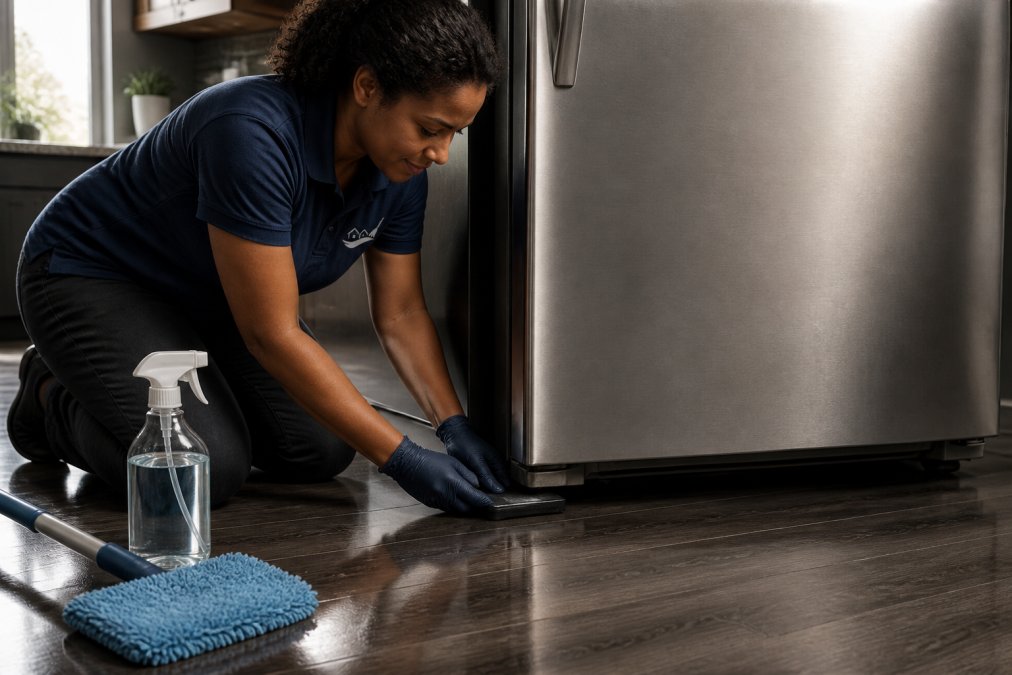
Begin by unplugging the refrigerator. If your unit has a water line for the ice maker, check whether it has enough slack to slide forward; if not, shut off the water valve and disconnect the line before moving it.
Once unplugged and prepped, follow these steps:
- Pull the unit out: With a helper, grip the sides of the refrigerator and pull it straight out from the wall, using the sliders to glide it across the floor. Pull far enough to access the back and sides comfortably.
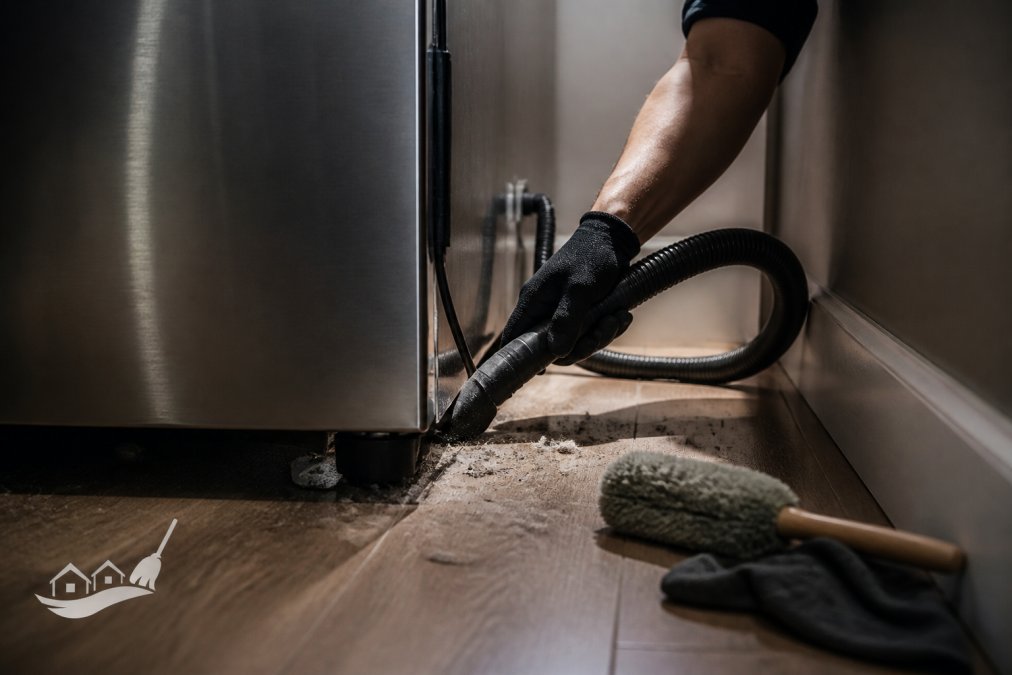
- Vacuum the floor and wall: Use your vacuum's crevice tool to remove loose dust and debris from the exposed floor and the wall behind the unit. This is where you will find the majority of dust bunnies.
- Wipe down surfaces: Dampen a microfiber cloth with mild detergent and wipe the lower walls, baseboards, and the back panel of the fridge to remove sticky residue.
- Clean the drip pan: Slide out the drip pan located at the bottom of the fridge and wash it in the sink with warm, soapy water. Let it dry completely before sliding it back in to prevent odors.
- Push the unit back: Carefully slide the refrigerator back into position, making sure the leveling legs are adjusted so the unit sits evenly and the door seals properly.
How to Clean Refrigerator Coils
The condenser coils are the black, grill-like tubes on the back of the unit or behind a kickplate at the bottom front. Cleaning them is the single most impactful task for energy efficiency, as dust acts as an insulator.
- Locate the coils: Check the back panel first. If they are not there, look for a grille at the bottom front of the fridge.
- Unplug the refrigerator: Never clean the coils while the unit is running.
- Use the coil brush: Gently run the brush along the coils to loosen the dust and pet hair. Work in the direction of the coils to avoid bending the thin metal fins.
- Vacuum the debris: Follow up with your vacuum's crevice tool or soft brush attachment to suction away the loosened grime.
- Clean the fan and grille: While you are back there, wipe down the fan blades and the intake grille to maximize airflow.
How Often to Clean Behind Stove and Other Appliances
For the stove, grease buildup from daily cooking means you should clean behind appliances at least every three to six months, focusing on the stove and underneath it. If you have shedding pets, do it more often, as pet hair mixes with grease to create a stubborn film.
| Appliance | Cleaning Frequency | Primary Concern | Time Needed |
|---|---|---|---|
| Refrigerator Coils | Every 6 months | Dust and pet hair restricting airflow | 15-20 minutes |
| Behind Refrigerator | Every 6 months | Dust, debris, and drip pan odors | 15-30 minutes |
| Behind Stove/Range | Every 3-6 months | Grease buildup and food debris | 15-30 minutes |
| Under Dishwasher | Annually | Dust and potential leak detection | 10-15 minutes |
A powerful range hood that vents outside captures most grease before it settles, allowing you to stretch the interval to six months. Without good ventilation, the film on the wall will be much thicker, requiring more frequent attention.
The Hidden Reason to Clean More Often: Pest Prevention
Beyond dust and grease, there is a compelling reason to keep these zones clean: pest prevention. Crumbs and grease behind a stove are a primary food source for pests, and a dirty, warm space behind a refrigerator is an ideal nesting spot.
- German Cockroaches: These pests are attracted to grease and food residue. They thrive in the warm, dark environment behind a refrigerator motor and under a stove. A single female can produce up to 30,000 offspring in a year. Regular cleaning removes the food source that sustains them.
- House Mice: Mice can squeeze through a gap as small as a dime. They are attracted to food debris and will nest in the insulation under a stove or behind a refrigerator. Droppings and urine contaminate the area and pose a health risk.
Wipe down the floor and wall behind the stove every time you deep clean the stovetop. For the refrigerator, check the drip pan every three months; a full drip pan breeds mold and provides a water source for pests.
Ergonomic Safety: Protecting Your Back While You Clean
The most common injury from this chore comes from moving, not cleaning. Proper lifting mechanics matter more than raw strength.
- The Two-Person Rule: A standard refrigerator weighs between 200 and 400 pounds. An empty stove weighs 100 to 150 pounds. Attempting to move these alone is a recipe for a herniated disc. Always have a second person to help guide the appliance and share the load.
- The Push, Don't Pull, Technique: When sliding the appliance back into place, push with your legs and body weight, not your arms and back. Keep your back straight and your core engaged. When pulling the appliance out, use a strap or have your helper pull from the front while you guide from the side.
- The Hip Hinge: If you must lift one corner of the appliance to place a slider underneath, do not bend at the waist. Hinge at your hips, keep your back flat, and bend your knees. Lift with your leg muscles, not your lower back.
- Clear the Path: Before moving any appliance, ensure the path to the cleaning area is clear of toys, pet bowls, and loose rugs. Tripping while holding a 300-pound refrigerator is a catastrophic scenario.
When to Call in the Professionals
If you have a gas stove and are uncomfortable disconnecting the gas line, or if your refrigerator is built into a tight cabinet space that makes maneuvering dangerous, call a professional.
Professional deep cleaning services have the commercial-grade tools and experience to handle these tasks safely and efficiently, ensuring every hard-to-reach area is addressed.
We provide professional residential cleaning services designed to transform your living space, ensuring that even the spots you cannot see are spotless.
Frequently Asked Questions
How can I clean the wall behind my stove?
After pulling the stove out, spray the wall with a degreaser and let it sit for a few minutes to break down grease buildup. Wipe it down with a sponge or microfiber cloth using a mild detergent and warm water. For stubborn spots, a paste of baking soda and water works well. Rinse the wall with a clean, damp cloth and dry it thoroughly before sliding the stove back.
Is it safe to move a refrigerator to clean behind it?
Yes, it is safe if you take the right precautions. First, unplug the refrigerator. Check that the power cord is not tangled or stretched as you move it. Use appliance rollers or furniture sliders to protect your floor from scratches. Move it slowly and carefully to avoid damaging the appliance feet or leveling legs. Also, be mindful of the water line if your refrigerator has an ice maker or water dispenser.
What is the best tool to clean under and behind appliances?
A vacuum with a crevice tool is the best first step to remove dust bunnies and debris. For dust clinging to coils and vents, a soft-bristle brush attachment or a specialized coil cleaning brush is very effective. A flat microfiber mop is ideal for wiping the floor and wall once the larger debris is gone. A tube brush can help clean the floor area right where the appliance feet rest.
How often should you clean behind your stove?
For most homes, a thorough deep clean behind the stove is recommended every 3 to 6 months. This frequency prevents grease buildup and reduces the risk of pests. However, if you cook frequently or often prepare foods that splatter grease, you may need to do this more often, perhaps every 2 to 3 months. A quick monthly sweep with a vacuum crevice tool can help maintain cleanliness between deep cleans.
Cleaning behind appliances is a dirty job, but it is one of the most effective ways to protect your investment and keep your home healthy. If you would rather spend your weekend enjoying your home than wrestling with a refrigerator, Maticulous Cleaning offers professional residential cleaning services built on meticulous attention to detail and reliable service. Get started with Maticulous Cleaning and enjoy a cleaner, better place to live.